
What is Third Party Pharma Manufacturing? Meaning & Process Explained
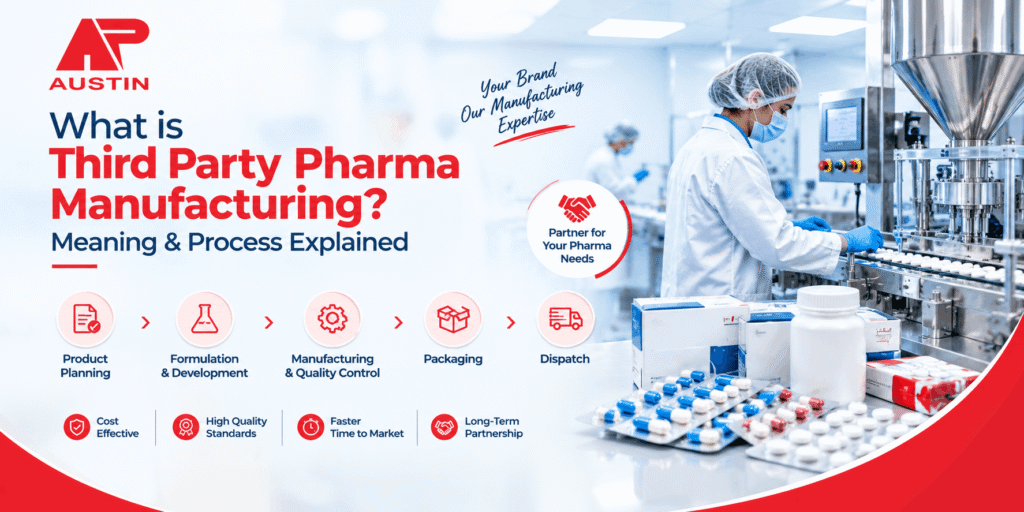
What is Third Party Pharma Manufacturing? Meaning & Process Explained If you’re planning to launch your own pharmaceutical brand without setting up a manufacturing unit, third party pharma manufacturing is the route almost every successful pharma startup and PCD company takes. It lets you sell medicines under your own brand name while an experienced, WHO-GMP certified manufacturer handles production, quality control, and compliance on your behalf. This guide breaks down exactly what third party pharma manufacturing means, how the process works from formulation to dispatch, and why it has become the preferred model for building a pharma business in India. Contact us What is Third Party Pharma Manufacturing? Third party pharma manufacturing — also called contract manufacturing or loan license manufacturing — is a business arrangement where a pharmaceutical company outsources the production of its medicines to another licensed manufacturer, instead of producing them in its own facility. The brand owner supplies the formulation, packaging design, and brand name, while the third party manufacturer handles raw material sourcing, production, quality testing, and packing under a signed manufacturing agreement. The finished products are sold under the brand owner’s name — the end customer usually has no idea the medicine was manufactured at a different facility. This is different from a PCD (Propaganda Cum Distribution) pharma franchise, where a company gets distribution and marketing rights for an existing brand’s products in a specific territory, rather than manufacturing rights. How Does Third Party Pharma Manufacturing Work? (Step-by-Step Process) Step 1: Formulation & Product Selection The brand owner decides which products to launch — tablets, capsules, syrups, injectables, ointments, or specialty ranges — either from the manufacturer’s existing product list or as a custom formulation. Step 2: Choosing a WHO-GMP Certified Manufacturer This is the most critical step. The manufacturer should hold a valid WHO-GMP (Good Manufacturing Practice) and WHO-GLP (Good Laboratory Practice) certification, along with a drug manufacturing license issued under Schedule M of the Drugs and Cosmetics Act. Step 3: Signing the Manufacturing Agreement (MOU) Both parties sign a Memorandum of Understanding covering minimum order quantity (MOQ), pricing, payment terms, packaging specifications, and confidentiality of the formulation. Step 4: Regulatory Documentation & Approvals The manufacturer applies for product approval from the State FDA/DCGI where required, and prepares the drug license documentation, product permission, and labeling compliance under the Drugs and Cosmetics Rules. Step 5: Production & Quality Control Manufacturing begins in the GMP-certified facility, with in-process quality checks at every stage — raw material testing, blending, formulation, and finished-product testing in an accredited quality control lab. Step 6: Packaging & Private Labeling Products are packed with the brand owner’s design, logo, and labeling — this is where the “private label” nature of third party manufacturing comes in. Packaging must comply with Schedule H/H1 labeling norms where applicable. Step 7: Dispatch & Logistics Finished, quality-approved batches are dispatched to the brand owner’s warehouse or distribution network, ready for sale under their own brand name. Why Do Pharma Companies Choose Third Party Manufacturing? No capital investment in a manufacturing plant no need to invest in land, machinery, or GMP infrastructure Faster time to market products can be launched in weeks instead of the years it takes to set up a facility Access to established quality systems WHO-GMP certified partners already have the regulatory approvals and testing infrastructure in place Focus on sales & marketing brand owners can concentrate on building distribution and doctor networks instead of managing production MOQ flexibility many manufacturers offer manageable minimum order quantities suited to smaller and mid-sized pharma companies Third Party Manufacturing vs In-House Manufacturing Factor Third Party Manufacturing In-House Manufacturing Capital investment Low (no plant setup) Very high Time to launch Weeks 1–3 years Regulatory burden Shared with manufacturer Fully on the company Scalability Easy — add products quickly Limited by own capacity Control over process Moderate Full Who Should Opt for Third Party Pharma Manufacturing? New pharma companies and startups launching their first product range PCD pharma franchise companies wanting their own private-label products Doctors, distributors, and marketers looking to start a pharma brand Established companies expanding into a new therapeutic segment without new plant investment Ready to Launch Your Own Pharma Brand? Partnering with a WHO-GMP certified third party pharma manufacturing company gives you a faster, lower-risk path to building your own brand — without the cost and complexity of setting up a manufacturing unit. [Get in touch with our team] to discuss your product range, MOQ requirements, and timelines. Third Party Pharma Manufacturers in Punjab Antibiotics Manufacturing Company in Himachal Pradesh Diabetic Range Manufacturing Company in Tamil Nadu Send Us a Message Our Contact Details BILLING & DISPATCH 7717302850 | accounts@austinpharmaceutical.com RATE ENQUIRY 7717302851 | 9501545951 | sales@austinpharmaceutical.com PRODUCT STATUS 9815949011 | production@austinpharmaceutical.com PURCHASE 9815577221 | purchase@austinpharmaceutical.com Office Address E-40, INDUSTRIAL FOCAL POINT , DERABASSI-140507